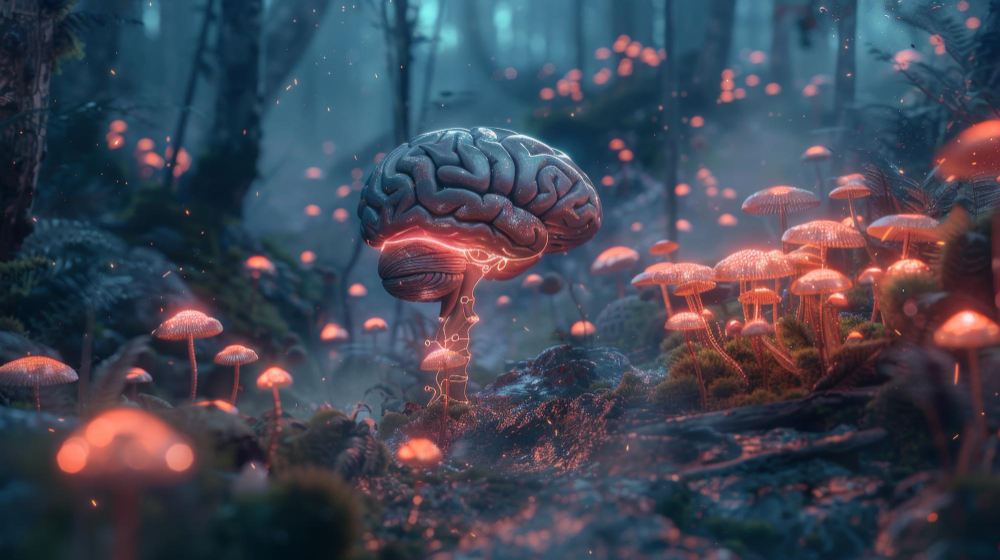
Depression isn’t just about feeling sad. For millions of people, the most exhausting part is the relentless mental replay—the same fears, regrets, and self-critical thoughts cycling through the mind on repeat. This pattern, called rumination, can make recovery feel impossible even when someone is doing everything right. Now, emerging research on magic mushrooms suggests a potential path forward by targeting the brain circuits that sustain these destructive loops.
New research is revealing how magic mushrooms may physically interrupt the brain circuits that keep these loops running. The active compound—psilocybin—appears to rewire neural pathways in ways that traditional antidepressants cannot. And as scientific interest grows, so does a broader cultural movement exploring psilocybin through microdosing practices and emerging product formats like gummies, chocolates, and beverage mixes.
The Brain Science Behind Getting “Stuck”
Rumination isn’t just a bad habit—it’s a biological process. When certain neural networks repeatedly fire together, their connections strengthen. The brain essentially builds highways for negative thoughts, making it easier to return to the same distressing content over and over.
Alex Kwan, a biomedical engineer at Cornell University, describes this dynamic directly: “Rumination is one of the main points for depression, where people have this unhealthy focus, and they keep dwelling on the same negative thoughts.”
These mental loops crowd out other forms of thinking. Pleasure, curiosity, problem-solving—they all get harder to access when the brain defaults to repetitive self-criticism. Traditional antidepressants work by adjusting neurotransmitter levels over weeks or months, but they don’t necessarily change the underlying circuitry. This is where magic mushrooms may offer something different.
How They Work Differently Than Conventional Medications
Magic mushrooms contain psilocybin, a compound that works through serotonin receptors in the brain. But unlike conventional medications, psilocybin appears to temporarily reorganize brain activity itself. During this window, communication between brain regions becomes more fluid, and rigid signaling patterns may loosen.
In 2021, Kwan’s laboratory demonstrated that psilocybin reshapes brain connections in ways that persist after the acute effects wear off. But the mechanism remained unclear—why did some neurons increase connections while others reduced them?
To investigate how psilocybin affects neural wiring, researchers used a specially engineered rabies virus that can trace neural connections by leaving fluorescent markers. “Here we use the rabies virus to read out the connectivity in the brain,” Kwan explains. This technique provided an unusually detailed map of how the compound changes the brain’s wiring.
What the Research Revealed About Brain Rewiring
In the study, mice received a single dose of psilocybin. One week later, researchers examined the patterns of neural connections. The results showed specific, directional changes rather than random disruption.
Regions involved in sensory processing became more strongly connected to areas responsible for action. Meanwhile, connections within the cortex were reduced—particularly in areas associated with the internal feedback loops linked to repetitive thinking.
“By reducing some of these feedback loops, our findings are consistent with the interpretation that psilocybin may rewire the brain to break, or at least weaken, that cycle,” Kwan explains.
The key insight: psilocybin doesn’t force the brain into a positive state. Instead, it may reduce the dominance of circuits that sustain negative thought patterns.
Why Magic Mushrooms’ Effects Seem to Last
One of the most striking aspects of psilocybin research is durability. Many participants in clinical trials report sustained improvements weeks or months after treatment—often without continued dosing.
The brain rewiring observed in animal models offers a possible explanation. When neural circuits reorganize after treatment, the brain’s default patterns shift. Rather than snapping back to old habits, the mind may become more flexible and responsive to new experiences.
The research also found that brain activity influences where rewiring occurs, suggesting context matters. This opens possibilities for combining psilocybin with targeted therapeutic approaches to guide brain changes more precisely.
The Rise of Magic Mushrooms Products and Microdosing Culture
While clinical research uses pharmaceutical-grade psilocybin in controlled settings, a parallel movement has emerged outside the laboratory. Microdosing—taking sub-perceptual amounts—has gained popularity among people seeking subtle cognitive or emotional benefits without a full psychedelic experience.
This cultural shift has driven demand for more accessible formats. Psilocybin gummies have become popular for their precise dosing and ease of use. Chocolates offer a familiar delivery method that masks the earthy taste. Beverage mixes and teas provide another option for those who prefer to integrate the compound into daily rituals.
Proponents of microdosing report benefits like improved mood, enhanced creativity, and reduced anxiety—though scientific research on these specific claims is still catching up. The practice has found particular traction in wellness communities, creative industries, and among professionals seeking alternatives to conventional mental health treatments.
It’s worth noting that psilocybin remains a controlled substance in most jurisdictions. However, decriminalization efforts in several U.S. cities and states, along with regulated therapeutic programs in places like Oregon, have created new legal pathways for access. This shifting landscape has accelerated both research and public interest.
What Magic Mushrooms Could Mean for Depression Treatment
Human brain imaging studies align closely with the animal research. People undergoing psilocybin-assisted therapy often show reduced activity in rigid, self-focused networks and increased communication between brain regions that normally operate separately.
In clinical settings, the compound isn’t administered casually. Participants receive psychological support before and after the experience. The goal isn’t to escape emotions but to change how the brain processes and responds to them.
The researchers see this work as a foundation for future exploration. “Our study hints at an exciting avenue for future research to combine neuromodulation with psychedelics to precisely target [and rewire] specific circuits,” they conclude.
A Shift in How We Think About Mental Patterns
Depression often convinces people their thinking patterns are permanent. The same thoughts return day after day, reinforcing the sense that change is impossible. Research on magic mushrooms challenges this assumption by demonstrating that even deeply entrenched circuits can be altered.
This doesn’t mean psilocybin replaces therapy, lifestyle changes, or medical care. But it may complement practices that support mental flexibility—mindfulness, physical movement, meaningful connection, and restorative sleep all encourage the brain to explore new patterns rather than defaulting to old ones.
Whether through clinical treatment or the growing interest in microdosing and alternative product formats, one idea is gaining traction: when rigid mental loops loosen, the mind gains room to move. For people living with depression, that shift can create space for new perspectives, emotional relief, and the possibility of lasting change.
This article is for informational purposes only and does not constitute medical advice.